Showing posts with label [07] Traditional Culture. Show all posts

Sunday, July 24, 2011

Asakusa or the ancient (and touristic) Tokyo

It's impossible to talk of a visit of Tokyo without talking of the district of Asakusa, a district of the North-East of the city which is full of tourists... which can be explained by the famous monuments it contains (as the Sensô-ji) and by the concentration of souvenirs shops.


A short visit of Asakusa

In Asakusa (cf. Usefull informations), the most common choice of tourists is to pass though the huge gate which should be on your right if you arrive from Asakusa Station. Its name is Kaminari-mon, the door of the Thunder which contains in its pilars two Gods (of wind, on your left, and of lightning, on your right). The most impressive thing was, for me, the big lantern under which you will have to pass and... the shoes you will find attached on the left pilar after passing the gate: this giant shoe was forgotten by a giant bouddha some years ago...

Le Kaminari-mon côté Namikase-dôri


Once you have passed the Kaminari-mon, you arrive in Namikase Dôri (or street), particularly animated... and full of tourists. This is not a surprise as all the shops sell souvenirs or O-miyage, in Japanese: it is a tradition in Japan where a travel is always followed by a distribution of gifts for all the people who were aware of your trip (your colleagues, friends and family). If you do not do it, even if you are a foreigner, it does not go down well. The street Namikase will let you prepare your come-back to your home country with a lot of traditional gifts from Japan: engravings, cats, chopsticks, small Japanese pastries, flags, key chains or fans...

La Namikase dôri


At the end of this chain of shops of 500 meters, a new gate, called Hôzô-mon, anounces the entrance of the shrine Sensô-ji or Asakusa Kannon (name of the divinity to who it has been erected). It is the most ancient and known Tokyo's shrine: it appears that it was founded in 628 by three fishermen before being built as we saw it now in 1692. Although it was destroyed during the World War 2, it was identically built again. It is surrounded by many buildings, as a pagoda of 5th floors, on your left. On your right, a little farther, you should find the Asakusa-Jinja, a sanctuary which has been made to thank the three fishermen who founded the Sensô-ji. This little shrine is the point from where the procession of the Sanja-matsuri, the biggest shintoist festival of the world, begins each year, on the 3rd weekend of may, also to thank the three fishermen. If you are not in Japan on may, maybe you will be at the beginning of april: on the 8th, there is the Flower day and many children parade at the Sensô-ji.

Hôzô-mon


Sensô-ji


The visit of Asakusa is already almost done. Then, you can decide to reach Yoshiwara (around 1,5 kilometers away at the North), a former district of brothels of Edo (the former name of Tokyo) or choose to lose yourself in the little streets all around Asakusa Station. If you have to go back to the station and to the gate Azuma (or Azumabashi), do not forget to look up and to notice the golden flame on the building of the famous brend of Japanese bier: Asahi... a piece which was realized by a French designer: Philippe Starck.

Wish you a good visit !


Marièke Poulat


Little story: O-mikuji

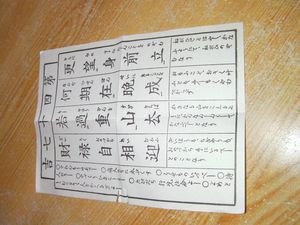
If the number of tourist is sometimes a problem when you visit a country, it can also be an advantage... For instance, at the Sensô-ji, you will be able to read O-mikuji (good fortune teller) in English to try this Japanese tradition for 100 yens (while most of the time these littles papers are in ancien Japanese). An O-mikuji is a little paper you can pick or choose thanks to an explained ritual (you have to shake a box to receive a numeroted stick which indicates you which drawer you have to open). The paper you receive announces your fortune... and if it is a bad one, you can give up your little paper in the court-yard of the shrine: therefore, the gods will forget you.


Un O-mikuji

Usefull informations

Access: To access Asakusa, you have two options:
Asakusa stop on the Toei Asakusa Line which is the closest station from the Kaminari-mon.
For those who chosed the JR Pass and who prefers the use of Yamanote Line, you can get off at Ueno Station and walk. Go outside on Higashi Ueno 3 Exit and take the street Asakusa-Dôri. Walk straight for about one kilometer and turn left on the street Namikase-Dôri: after 200 meters, you cannot miss the Kaminari-mon in front of you.


Take a look on Google Map


Make the map bigger


Accomodation: Located on the closest part of Tokyo from Narita Airport, there are a lot of facilities to stay at Asakusa for really reasonnable prices (around 2000 yens for a night without breakfast). You also can stay longer, for one week or more, as there are some discounts for long stays in some of these accomodations. These places can be really fun even though it is not always really confortable (dorm or private rooms for 1,2 or 3 people but it is more expansive). One of these inns is les auberges Khaosan.

International Museum of Manga (Kyoto)

Settled in a former primary school and surrounded by a parc made with synthetic grass to let people read a borrowed manga lying in it, International Museum of Manga of Kyoto is a haven of peace. Caution : fan of manga you could forget the world around you... and even more if you have some basis of japanese.


Museum Entrance


Visit of the museum

Open in 2006 by the city of Kyoto in collaboration with the Seika University, which offers a manga section, the museum has been settled in a former primary school. That is why its organisation is quite intricate. After crossing the courtyard of synthetic grass where lectors can lie to read when the weather is good, we arrive in the hall. Then you can reach the cashier where they will speak to you in English or in Japanese. On your left, the entrance of the exhibition with comics from all around the world (say hello to the French Titeuf and the Belgian Tintin), and on your right, a shop where you can find some mangas, of course, but also artbooks, goodies and other specialized books to learn how to draw mangas.

There are a lot of temporary exhibitions. When I visit the museum, it was the week of the demonstration of the students'works of the university: I saw their projects: drawing, storyboards, mangas and other illustrations at the entrance of the museum and short movies were broadcasted on a giant screen. Students were around explaining their projects... even if my bad level of Japanese was a barrier... For these events, you can check the english of the museum which is quite furnished.

The most impressive part of the museum, I thought, was on the second floor of the museum when I discovered the wall of mangas... A room whose walls are entirely covered with mangas classified in alphabetic, gender and year order. Naruto and One Piece are definitively not the only mangas... even if they are the best known in France. At the center of this room, some temporary exhibitions with drawings of the biggest mangakas and some games in Japanese. The following rooms, linked by corridors covered by mangas, present the process of fabrication of a manga, how it is made, drawn... (the story, the storyboard, the drawing...).

Due to the impressive amount of books and explanations which describe each piece, it is really interesting to have basis of Japanese language to appreciate entirely the place and to lose yourself in it. Indead, the museum is full of benches and coaches where you can seat to imerge yourself in mangas. But Japanese knoledges are not necessary to understand everything. Your eyes will shine even if you are not able to decipher a single word: the amount of images the museum contains should be enough to spend a great amount of time in it if you are a lover of art or if you have any interest in drawing (and not fundamental in mangas as the presented drawings are not always stylised one).

Usefull informations

The museum is located on the street Karasuma-Oike, in the disctrict of Nagagyo-ku. From the main station of Kyoto, you can take the Subway Karasuma line and get off at Karasumaoike stop around ten minutes later. It should cost you 210 yens. From the same station, you can also decide to walk: there are only three kilometers between it and the museum.


Make the map bigger


It is opened every days (except wednesday) from 10 am to 6 pm. You can enter it until 30 minutes before the closure but you should not stay there for only half-an-hour: it is too short to really enjoy it ! During summer, between the 14th of July and the 31st of August 2011, the museum never close (even the wednesdays) and you can stay until 8 pm. Exceptionnally, the museum is closed during the New Year Hollidays (at least the fourth first days of January while almost all Japan stops leaving) and for three days in the year for the maintenance.

To enter the museum, you will have to pay 800 yens for the adults, 300 yens for middle and high school students and 100 yens for primary school students. As many museums in Japan, there is no discount for students of University... There are some advantages for those who want to go to the museum quite often: there exist the MMPass with illimted access to the museum and of its library but not to the temporary exhibitions. It is 6000 yens for adults, 3600 for middle and high school students and 1200 for primary school students. The entrance is sometimes free for some events, as for the week of the exhibition of the students of Seika university where I went by chance at the end of February in 2011.


Conclusion

After the visit of three shrines, two museums of Japanese drawings and calligraphy and of four commercial centers, a stop is inevitable at the International Museum of Manga. First, because it is the only existing one in the whole world. Second, because mangas are an another part of Japanese culture worth seing. And last but not least, because what is presented is basically beautiful.


Marièke Poulat


* Website in English and in Japanese :
http://www.kyotomm.jp/
http://www.kyotomm.jp/english/

Saturday, July 16, 2011

One day in Yokohama

Yokohama is not only a famous brend of motorcycle : it is also the name of one of the biggest cities of Japan (with more than 3.5 millions of unhabitants), located in the suburb of Tokyo. You need less than 45 minutes to reach Tokyo when you are in Yokohama and many students who are from this city just make the back and forth everyday. A journey that you absolutely should do to discover this city if you are staying in Tokyo for more than one week.

To go to Yokohama from Tokyo

It is particularly easy to go to Yokohama from Tokyo, thanks to the numerous lines of train which are between the two cities and which are regulated by the JR East. The shortest and cheapest solution is to depart from Shibuya Station, with Tokyu Toyoko Line which leads you to the main station of Yokohama (whose name is Yokohama station) in 25 minutes for 260 yens (less than 3 euros !). But you can also depart from Shinjuku and Ikebukuro Stations with Shonan Shinjuku line (around 30 minutes and 540 yens, or 20 minutes and 380 yens if you go on the train in Shibuya). And one another solution (but there are actually plenty of them) is to depart from Tokyo or Shinagawa Stations by Tokaido line : 25 minutes and 450 yens from Tokyo Station or 20 minutes and 280 yens from Shinagawa.

Once you are in Yokohama, you can decide to walk through the city (which can be interesting and beautiful as the balnear city is quite calm and net) or to take the subway to go faster to the place you want to see. There are also some bus which can drive you to the main stations.

Yokohama’s places to visit

There are numerous to see : the parks, the stadium (where the Final of World Cup of 2002 was payed and where many concerts take place), the port, the museum of ramen (yes, it actually exists), a shrine where many soccer players go to pray before matches or the Chinatown… Yokohama is also one of the first place in Japan where strangers arrived and that explain the presence of an international graves. And this is also a balnear city where it is really agreable to pass by and to buy souvenirs. Yokohama is not only a dormitory but a real city, particularly specialised in entertainment, as a giant Odaiba, with some amusement parks and commercial centers. Some characteristics which turn the city into a place to visit for at least one day or more.

Zoom on the Chinatown

If Tokyo does not have a Chinatown, it has been settled in Yokohama for more than one hundred and fifty years. Officially recognized in 1955 with the construction of a goodwill gate as the main entrance of the district, it has been built after the landing of the first Chinese migrants in Japan. It is the biggest Chinatown of Asia with between 3000 and 4000 unhabitants, even if only a few of them are Chinese nowadays. It also counts a lot Chinese restaurants but if you really want to eat Chinese food there exists a lot of cheaper places in Tokyo : it seems that the status « Chinese restaurant of the Chinatown » is quite expensive for the same quality.

Even though Yokohama is close to Tokyo (in situation and in architecture), it is a slower city. Maybe it is more european in its way of living and of being organised. It is a beautiful city to discover if you are going to stay during a quite long time in Tokyo. However, if you are only spending some days in Japan’s capitale, you should choose to go either in Odaiba (which is closer and an Island of entertainment) or in Kamakura, a little farer but actually more interesting as a cultural visit (with shrines, temples and the Daibutsu).

Marièke Poulat

Friday, July 8, 2011

Green tea and matcha powder


Not only it is a host in all our cups during all our meals and in the traditionnal tea ceremonies, but Japanese green tea is also turning in green many Japanese pasteries. Let’s discover this product that you should not miss while travelling in Japan.

Green tea everywhere…

In either school restaurants, small shops which serve some traditionnal plain meals in some industrial quantities, or on the contrary, in fancier restaurants the fashionable soft drink is green tea. The only thing which differs is the quality of it. And therefore is taste. For instance, in Waseda University’s school restaurant in Tokyo, dispensers offer green tea, hot water and fresh water… but green tea is not really tasty as there must be too much water in it. In many restaurants then, you will have to ask for fresh water if you want some, because they are going to serve you hot green tea*. And in others, you will find some taps delivering hot water and green tea powder you will have to shake to create your own drink. There again, you will have to ask for fresh water if you do not like green tea.

Fancy Green Tea

Reading the latest sentences, it is easy to deduce that green tea is a low cost product in Japan. Which is definitely wrong. Let’s examine wine, in France : there actually exist some low cost wine, which cost less than some euros, but it is also possible to find some « Grands Crus » which are very expensive… This is the same with green tea in Japan. The most expensive, the King of Green Masa super premium, cost more than 2500 dollars for one bottle of 750mL !

A special green tea : matcha

Matcha is a very special green tea as it is not from leaves that you are going to put into water to create you beverage. It is a powder that you have to blend into hot water to create a really think and bitter tea. It is also used while tea ceremonies where it is drank with some sweet pasteries made from azuki (red beans paste) to limitate its bitterness. Many international people and even Japanese people do not like this drink very much for the first time… a recurring joke in Japanese dramas being the grimaces people make when trying green tea for the first time.

Matcha is everywhere…

This matcha powder allows the use of the characteristic flavour of green tea in many products : in beverages but also in some pasteries. For instance, one of the favourite drinks in Japanese coffee shops, as Starbucks (or Veloce Café, Tully’s coffee…), is matcha latte : it is a drink close to a coffee latte, with milk and cream, but with green tea flavour. On reverse to the strong and bitter match tasted during tea ceremonies, it makes very soft and sweet drinks… as for the bubble teas with matcha flavour**. Added to these drinks, it is also possible to find Japanese pasteries with this flavour…which have all the same characteristic. All of them are green ! There are green cookies, donuts, cakes, cheese-cakes or even green kitkats ! And if you want to try to make this kind of pasteries, it is possible to make them everywhere in the world as you can buy matcha powder in many tea shops and find some recipes on internet.

A good way to try this peculiar flavour at home before going to Japan where you will have to taste it ! But remermber that even if you do not appreciate it, you should be able to survive… but it is true that if you like it, it will be easier for daily life and to meet Japanese people ;)

Marièke Poulat

*****

* To those who do not like green tea the magical sentence is « Sumimasen, O-mizu ga arimasu ka ? » « Sorry but do you have any water ? ».
** See the article on Bubble tea if you have not read it already and above all if you do not know this surprising beverage ^^

Gyudon or the dark side of Japanese cuisine


Far from the famous delicateness of sushis, Japanese cuisine counts plainer dishes... and stodgier, as for our ham and cheese sandwich or our cheese omelett. A perfect demonstration of that assertion is Gyudon, or its improved version : oyakodon. These are dishes made with rice served in a bowl for only some hundred yens and therefore are ideal to feed salarymen when they leave their work.

A unique heavy dish

Made from slices of cheap (fat) porc, gyudon and his even heaviest version oyakodon, is a heavy dish. Therefore, it is a good way to feed salarymen after work or tired tourists who have walked all day long. With more than 800 calories for one bowl (even for the S/small ration), it is a bowlof rice topped with slices of porc cooked with onions... the all topped by a boiled egg if you ask an oyakodon. You can also add ginger and soy sauce to it. This cocktail is then quite stodgy but really appreciated by Japanese and international people, particularly during the winter when it is served with a hot green tea.

Oyakodon

 
Available in many places...

If this dish is really traditionnal, places which serve it are also quite surprising. In Japan, three chains of restaurants are weel known to offer gyudon: Matsuya, Sukiya and Yoshinoya. It is possible to taste it in more traditionnal shops, but the main advantage of these chains is that they are cheap (it is less than 300 yens or 3€ for one small bowl... with which you should be already pretty full) and omnipresent everywhere: in Tokyo, it is difficult to make more than 100 meters without finding at least one of these stores. Moreover, as they do not make many dish they make gyudon pretty well at least.

However, their serving is quite different. Yoshinoya is the biggest and offer a wider choice of sets and dishes. Moreover, its restaurants are more occidental, with a waitress to who you have to command and some tables, added to the traditionnal counter where Japanese people like to eat when they eat alone very fast. Two aspects which appear to be normal but which are in fact not so logical in Japan. Indead, both other chains have a different way of serving which should be able to interest the occidental that you are ;)

… with a 100% Japanese organisation

The first thing you will notice while entering Sukiya or Matsuya is the disposition of the room. If you enter a small restaurant at the center of the city, there will be only a counter around the stove where the cook is working. You will also remarke a ticket machine at one side. It presents all the dishes that the restaurant is selling and it is really easy to use: you only need to press the button with the picture of the meal you want, to pay the amount of money indicated and to take the ticket the machine delivers. You give it to the cook once you are sitted and some seconds later, a steaming bowl will be served to you. It's ready ! Now, you only have to eat it with the chopsticks made of plastic you should find in the plastic boxes you have close to you. You are also allowed to add some spicies in it, as ginger or red pepper... Do not add soy sauce in the rice at the end: it is really not polite in Japan ! So, you see, to eat gyudon is as easy as that: you do not even have to say a single word in japanese... an easy solution for those who are affraid to speak... and to those who want to discover a different way of life. 

Ticket machine at Matsuya

Because it is obvious that this is not the kind of restaurant you should chose if you want to try good Japanese cuisine. Besides, Japanese people do not go to these restaurants in that aim. These restaurants are some improved fast-food without burgers, a food factory where people keep entering and leaving after some minutes (I actually mean some minutes). This is a good way of experimenting one of the Japanese way of life... and a good solution if you are hungry at 3 a.m.: one of the caracteristics of these chains is to be opened 24 hours on 24 !

To be tested. Definitively.

Marièke Poulat

Saturday, June 25, 2011

Christmas in Japan


Halloween's decorations have just been put away in cupboards at the end of October when the different shop windows of Tokyo are covered with red and white of Christmas. All becomes tinsels, snow, christmas tree and candels. Streets follow at the beginning of December. The more known districts in Tokyo for their Christmas' illuminations are Shibuya, Harajuku or also Roppongi, but most of the streets of Tokyo are decorated. Streetlights are often surrounded by lights. In addition to this magical atmosphere, many European Christmas market are put in place, for instance in Roppongi, with the German one.

Roppongi Hills and its illuminations

In conclusion, the perfect Christmas'picture transposed in Tokyo. Transposed. That is the important word of the sentence. As the kind of Christmas that we know in France, a familial and religious celebration, has been adapted by Japanese people. Indead, in Japan, Christmas does not have the same values as French Christmas, which can be explained by the absence of catholical religion's print. Christmas is here a guy who wears red and white clothes giving presents thanks to his sleigh and his friends, hobgoblins and reindeers. Jesus' birth is forgotten and there is not any crèche settled under christmas trees and even less Midnight Mass in Japanese Temples and Shrines on the 25th of December.

In Japan, Christmas is the equivalent of the French New Year. It is celebrated by parties between friends, rendez-vous... Indead, it is above all a Love celebration and, in Christmas Eve, the tradition is to go out with your lover to admire illumination in animated districts of Tokyo after eating together. That is why you should not be surprised to find a Christmas Box in Mac Donald, for instance, a giant Happy Meal for two with nuggets, two drinks and a huge portion of frites to share.

« Christmas Box » by Mc Do for Christmas

Christmas at Mac Do or how Christmas and Christmas Eve dinner in Japan is not a good moment for gastronomy. No fois gras, no turkey served with chestnuts, no chocolates... Courses of the Christmas Eve dinner are the same as usually in Japanese families. The only diferences are the presence of fried chicken, kind of a giant nugget, in all combinis and of a cake for the desert... Which is important to notice as, first, most of the time deserts are absent at the end of the Japanese meals, and second, this is the Christmas Cake. A cake close to our Bûche de Noël in its texture, its favours (chocolate, coffee, chestnut...) but not in its shape, as it is rond.

Japanese Exceptions for Christmas Eve Dinner


Illuminations, lovers, gastronomy... but, where are the children ? After all, this is their favorite celebration in France ! They are the one spoiled there ! And in Japan too... Even if they do not avec the Advent Calendar which does not exist. However, they write their letter to the Father Christmas or Santa Claus and receive presents. But not under the Christmas Tree and even less in their slippers: I tell our habits to Japanese children and they were mezmerized. Presents are here left on their pillow or on their desk in Christmas morning. Like that, no need to leave the heat of the bed to open them. However, it is sometimes not a good idea to be precocious: some children stop to ask for presents to their parents when they discover who is the real Father Christmas. The story does not tell if parents impose that on their children or if they are really embarassed to ask for presents...

However, do not be to worried: they are not bullied. Indead, some days later, New Year arrives with its familial traditions and its presents. If Japanese Christmas is an event celebrated between lovers or friends, Japanese New Year, which is enjoyed in family, looks like the French Christmas and life just stops in Japan during the first days of January.

Marièke POULAT

Sunday, February 27, 2011

Valentine Day and White Day in Japan (Marièke POULAT)


Just like Christmas, which is a typically occidental event because of its religious origins and which has been adapted by Japanese people, many events exist in Japan under their occidental names but with totally different practices... That's for instance the case of the Valentine Day, lovers' day, celebrated the 14th of February, which takes a really different form from what exists in France and which is combined with the 14th of March, the White Day.

As all imported event, Valentine Day does not have an actual Japanese name. Only a translation in phonetic alphabet, the katakanas, from its English name: the Valentine Day is thus the バレンタインデー. More than its name, the event also keeps the same date, the 14th of February, the same meaning, as it is still a particular day for lovers, and the same commercial side... and maybe even stronger than what we have in France. Indead, from the 1st of February, and even sometimes a little before, shops offers Valentine Day's products... as chocolates, gifts, but also well decorated windows for hearts are everywhere.

However, the practice is completely different. If, in France, it is usual to send letters to the one you love, to make presents, to go to the restaurant, or to make your declaration or even your proposal in the 14th of February, in Japan, Valentine Day is celebrated differently. Here, the responsability of the Valentine Day is not shared. All the work is for the womankind... But, don't worry ladies: men are going to get even with some presents, one month after, for the White Day, in Japanese, the ホワイトデー, a day which does not have any equivalent in France... or even in Europe.

On the 14th of February, Japanese girls must offer chocolates to all the men for who they care. For instance, they can offer some chocolates to the men of their family, or to their friends and colleagues, and, of course, to their husband/boyfriend or to their love interest as a declaration. And, if they really want to respect the tradition, they have to make these chocolates by themselves... As the molds sold in most of the shops show it. In Tokyo Hands, big departement stores of Tokyo, which are notably in Shinjuku, Shibuya or in Ginza, there is a whole flour entirely dedicated to these molds which can have the classic shape of a heart to the exotic one of a colomb... Finally, it is usual to offer these chocolates in a box with a card, as we do it in France.

In compensation, if compensation exists in love... but there we enter a much more philosophical subject for this trivial article, men have to respond on the day of the White Day. This event, nonexistent in France, has been celebrated in Japan since 1980, but also in South Korea and Taiwan. Invented in Japan, even though its origins are quite fuzzy, it seems that it was at the beginning a way to ''repay their debt'' to the women who has bought them a present. It has been called the White Day for it is first a brend of white chocolate which got its hands on this commercial opportunity... before the practice has extended and that a white present has became the norm. Nowadays, if there are some rules (as the giri-choco offered as a thanks but without any love's feelings, or as the Sanbai Gaeshi (or « Thrice the return ») which implyes that the present offered must be three time bigger than the present received...), exchanged presents for Valentine's Day are similar to those which are given in France (as jewelleries, perfums...).

Actually, there is not only one Valentine's Day in Japan: Valentine's Day and White Day seem to be combined... which is really interesting for the different industries (of chocolates, but also of jewelleries, for the restaurants...). But, far from these economical issues which break the magic of this day (my romantic side is revealed here...), there exists a different adolescent practice for the White Day... Young men can offer a white ribbon to the girl they like: if she ties it before the end of the day (around her bag, in her hairs, in her clothes...), it means that she shares the same feelings... Isn't this cute, in this world of capitalism ? <3 ^^

Good バレンタインデー
And good ホワイトデー to you all !

Nomihodai, Nomi-what ? (Marièke POULAT)


All those who have been students or who have lived in a small appartement in their life are aware of this fact... This is complicated to invite some friends to party in an appartement of 10m2. A dilemna that Japanese people, students but also older people, also know as the average size of flats in Tokyo is really narrow. So, what can you do ? Be associal, invite only one people at once... Or, find a larger place with a table, some chairs, some food and, even better, something to drink... as to drink is here an institution and beer and sake (rice alcohol) are on the favorite alcohols. As an example, one of the first sentence that you learn in Japanese classes is « Sake o nomimasu » that you can translate by « I drink Sake » or « I drink alcohol » (as sake, in Japanese, means both sake, as rice alcohol, and alcohol). 

Japanese restaurants have well understood their interest and a large offer of places where you can eat and drink with your friends have been created, with different concepts. There are three major formulas: the Tabehodai (All you can eat), the Nomikai (All you can drink) and the Nomihodai, which combines both formulas, as it is a Nomikai and a lot of different dishes to absorb the quantity of alcohol swallowed... In fonction of the chain of restaurants, of the price, of the day of the week, or even of the district (Ginza, the fancy district of Tokyo, is for instance not offering the same services as Takadanobaba, the student district...), the offers are different... There exist, for instance, the innocent Sweet Paradise, where you can eat as cookies and ice creams as you want during one hour and a half for about 1500 ¥, but also some trash nomihodai where beer is flowing and where you can eat all the food you want as it is a self-service (about 2000¥ for two hours). 

If students are fond of this kind of meeting and go there with their friends, their clubs or even sometimes with their families, older people are not left aside. Many Japanese people go there with their colleagues and even with their superiors. However, the reasons to go to a nomihodai are different: the students like to go to nomihodai to have fun and to drink (as having fun and drinking are surprisingly often linked), while the nomihodai can be a working meeting between colleagues... According to a French expatriate, many decisions in the entreprises are taken in that kind of meeting. Of course, older people are also going to nomihodai between friend to have fun and drink, particularly at the end of the year or to celebrate the important events. 

This is difficult to describe exactly what happens in that kind of meetings... If the conventions are easy between friends, where the only goal is to have fun and to drink, it can be more complicated in presence of older people, the « Senpais », which is the title automatically given to the more experienced people in Japan. This situation can occure in the nomihodais organised by the clubs which also invite former members... The conventions are numerous, as the fact that the yongest must take care of the Senpai during the party, the fact that the Senpai must pay more than the others, or the fact that it is not polite to say « no » when the Senpai proposes to refill your glass for the umpteenth time on a row... Conclusion, if you want to « survive » you should drink slowly, by sips, to not empty your glass too quickly. However, to be « gaijin », the Japanese word for « foreigner », can help you as, if you are gaijin, you don't have to follow all of these conventions... but only some of them, as you can't avoid to do a little presentation of yourself (with a special mention if you can do it in Japanese), or to sing a song... Here, the tip is to not drink too much to be able to stand up when your name comes out and to have a song that you can sing quite well. This time, to be a gaijin is not so helpfull as the questions are numerous... and as it is always difficult to explain in some words (and in Japanese) how France and Japan are different... but it is always funny to discover what people think of you country.

Nomihodai, tabehodai and nomikai are commonplace in Japan and belong to Japanese culture. Most of Japanese people go to nomhodai at least once in a month, men going there more often than women. If the omnipresence of alcohol, particularly during Nomihodai and Nomikai, can incommodate, it is interesting to go there at least once. With Japanese friends. Because you will discover an another facet of the personnality of your friends/colleagues (maybe because they have drunk four glasses of beer before which uninhibitate them... but this is an another subject) and because it is a friendly event and, in a certain manner, a really traditionnal one.

POULAT Marièke


The 23rd of December in Japan (Marièke POULAT)


When his Majesty the Heavenly Sovereign of Japan, also known by non-Japanese speakers as Akihito1, celebrates his birthday, he does not take his people for fools. Not only the 23rd of December, the day of his birth in 1933, has been a day-off in Japan since he has become Emperor in 1989, but he also opens his residence, the Imperial Palace or Kōkyo in Japanese, to thousands of curious people. Moreover, he takes that event as an opportunity to make some public apparitions from his balcony and to pronounce a speech.

Since his Current Majesty, his other official title, came to the throne, after being enthrone as Crown Prince in 1951, his birthday has become a day-off. He is the 125th Emperor of Japan, from the line of descent Yamato which has reigned over Japan since -660 BC... a lenght which makes it the oldest dynasty ruling a country in the world. For a long time a sacred and important political character, the Emperor of Japan has a function of representation, as the Queen of England for instance. The Emperor lost all his political power and also his status of « Living God » in 1945. Nowadays, he is recognized as the Head of Japanese State by the other states and he is the symbole of the State and of the unicity of Japanese people.

Venered by his people, symbole of the traditionnal Japan, his statut appears to change, to modernize, little by little. Indead, the current Emperor is the first of the Japanese Emperors who received an education outside the Imperial Palace's compound, because of the Post War 1945 and the new opening-up of Japan on Occident which left a mark on his childhood. Akihito is also the first Emperor who married with a commoner, Michiko Shōda, who has become Empress Michiko of Japan. Later, the couple decided to bring up his childs, without the help of a preceptor. These choices create some debates even though they show a modernisation of the Emperor's function. However, this is a progressive modernisation as we were able to see it at the beginning of the 2000s while there was not any male heir: shall Japan let women come to the throne, while it is still forbidden by the 2nd Article of the Constitution of 1889 ? This debate finally ends in 2007 without a real political answer, after the birth of the Prince Hisahito, grandson of Akihito, in 2006, which postponed this debate about the absence of a male heir.

Far from this political considerations, the 23rd of December is a festive day in Japan which let Japanese people but also (and above all...) foreigners see their Emperor and access the Imperial Palace's gardens, while most of them are closed during the year. In this day-off, the several visitors can pass the Nijubashi Bridge and enter the compound of the Palace. This opening happens only twice a year: on the 23rd of December, as we have already said, and on the 2nd of January, to celebrate the New Year.

On this 23rd of December 2010, the Palace was open between 9:30 and 11:20 only, with three programmed apparitions of the Emperor around 10:20, 11:00 and 11:40. After some safety verifications, between bag and body's search, many meters covered almost running while being pushed by the policemen, we arrived to the famous Nijubashi Bridge. On the other side, the compound of the Palace and a huge square. People enter it slowly, caring Japanese flags distributed previously by the staff. The order is necessary and the number of policemen large: it seems complicated to imagine some deviant behavior. Moreover, the Medias are omnipresent in front of the Imperial balcony on the other side of the square: an incident could really give a negative image of the Emperor and of Japan.

The time of Emperor's apparition finally comes and he is really punctual: at 10:20, as it was expected, he appears, welcomed by applause. The crowd is waving its flags while he is greeting those who have come to celebrate his birthday. However, there isn't any cake. On the menu, a plain speech of thanks and of cheerings for the year to come. It is surprisingly short for a political speech and the crowd, who is silencious, makes disappear the flags, while he is speaking. Once his last words are pronounced and the Happy New Year wished, flags appear again during a short while, as a « Good Bye ».

It's already finished. Arrived at 10 in the Palace, we left at 10:45: the Emperor disappears and policemen are making the crowd to leave the square and leading it to the exit, which are the East Garden of the Imperial Palace... those which are opened all the year. But, as they are beautiful, calm, and even if we have already seen them, we do not hesitate to visite them again, as they are constantly changing, thanks to the seasons and the changing colors of the leaves... Thinking that these gardens are only the anteroom of the Imperial estate, it is a pity to reserve such a garden only to the relatives and the people close to the Emperor. Above all as this « Public Opening » is a little disappointing: if I will be able to pride myself on having see the Emperor for real, I did not see very well his Palace and his Estate. But this is how it works. There exist some priviledges that are not going to disappear soon... and with a Prince of only 4 years, it seems difficult to think about marriage to become Empress.  

So, the Emperor will just keep his Palace and his private gardens... and we will just look at Tokyo from the ground and not from a balcony. A seductive plan too, isn't it ?


Marièke POULAT

*****
 

1Even if it is usual to call the Emperor Akihito in Occident, it is considered as a lack of respect in Japan.

Thursday, January 20, 2011

New Year in Japan (Lin Te Kuan)


      This year I went to 增上寺 to count down to the new year and after then I went to 台場 to see the first sun rise in 2011. These two events were all very new to me. I found a lot of cool things about Japan in them!
      On the last day of 2010, my friends and I went to 增上寺 to count down to the new year and we wanted to see the beautiful Tokyo tower. We arrived at 9:30 at night. People were starting to gather in 增上寺. Around 10 pm, some people ran out and sang a song. Though I didn’t know the name of the song, but I liked it. After they finished singing, a girl ran out carrying a torch. Then they light up some spots. It’s quite interesting to see that because I have never seen anything like that before. What was even more fascinating was that增上寺 distributed eco-friendly balloons. But the number of the balloons is limited so I didn’t get the balloon. The purpose of the balloons was to make everyone let go of the balloon when the moment that the New Year comes. So when 2010 only had 10 seconds left, all of us in增上寺 shutting out loud to count down the time and then let go of the balloons. In a moment, all the balloons flew into the sky and the view was very beautiful and they also rang the huge bell in the增上寺. But I think the greatest of all is Tokyo Tower! It is always very gorgeous at night. When the first time I saw Tokyo tower, I couldn’t believe it can be so attractive. The beautiful orange light with night sky, the whole scenery was stunning. Everyone around me couldn’t stop looking at Tokyo tower just liked me. And when there were only few minutes in 2010, the light of Tokyo tower gone out, only a few purple lights sparkled. As the time of 2010 became less and less, those purple lights sparkled faster and faster. When 2011 came, the whole Tokyo tower was like being pasted with a lot of diamonds, sparking at night. Tokyo tower was the best part for my countdown event.
      After then, my friends and I went to 台場 to see the first sun rise in 2011. The weather was really cold, so we stayed in McDonald to wait. At first we thought there were not many people wanted to see sun rise as we do, but then as the time of sun rise became close and closer, people in McDonald became more and more. We asked the girls sat besides us what were they want to do, they told us they are going to see the sun rise! And when we get out of McDonald, there were a large crowd all going in the same direction. As we followed, we found that a lot of people were all going to see the sun rise. When the sun came out, Japanese around us were all very exciting!
    I thought these two events were very special because in Taiwan, we have concerts and fireworks so we won’t be so calm to count down to the New Year and won’t be so happy to see the sun rise! It seems that Japanese are really different from us, and that’s why I found it is cool!


Wednesday, January 19, 2011

Japanese etiquette (Jee In Chung)

      Every culture has its own unspoken rules of etiquette, but somehow they seem more noticeable in Japan then in other countries. As a Korean who has lived in North America, I found some of the rules very surprising.
このブラウザではこの画像を表示できない可能性があります。  Take, for example, the atmosphere in the denshya (subway), which I ride every day to school. Although it depends on which line you take, people are generally very quiet in the denshya. In other countries, students pile into subway cars chatting noisily about their school lives, their plans for the weekend, and so on. But in Japan, such behavior is considered very rude. Most people read books on the train and refrain from talking.
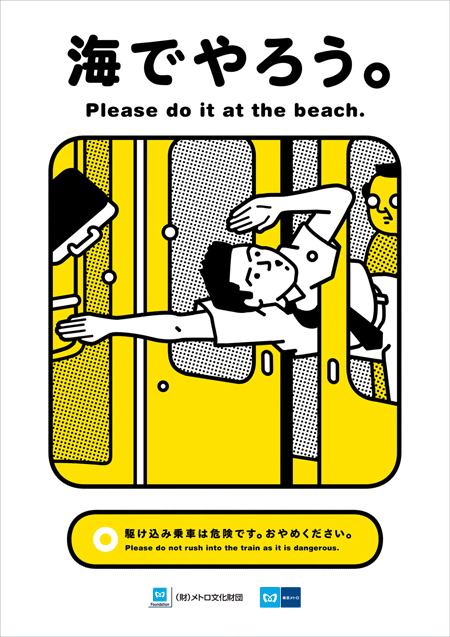
      In fact, any behavior that might disturb or inconvenience others is frowned on. On rainy days, I have noticed that most Japanese people carry full-size clear plastic umbrellas. But when they bring their umbrella onto the subway, they tie them up carefully so that no one else gets wet.
      In addition, it is forbidden to use cell phones in the trains. Announcements remind you of this rule over and over again. On one occasion I was surprised to see a junior high school student removed from the train for talking on his smartphone. In my hometown, Seoul, people are on the phone all the time in the subway, and they would be very indignant if anyone tried to stop them.
      It’s the same way with music. In the New York subway, you always hear music blasting from the earplugs of the person sitting next to you. Here in Japan, if your music can be heard by others, someone will invariably ask you to turn the volume down.
      In social gatherings, etiquette is even more carefully observed. When I received a Christmas dinner invitation from a friend, my Japanese teacher told me that it would be nice to  bring anomiyage (small gift) to show my appreciation. Before entering into the house, I took my shoes off and said o-jama shimasu (sorry for disturbing) while entering my friend’s house. As we began eating, we said ittadakimasu (thank you for the delicious meal) to our host.
このブラウザではこの画像を表示できない可能性があります。  The formalities of Japanese etiquette extend even to the way bowls and chopsticks are used. Japanese people hold their rice bowls up near their mouths while eating, whereas we Koreans keep the bowl on the table and bend down over it. Chopsticks in Japan are never used to point at things, and they are never stuck vertically into a bowl of rice because this is a sign of death. It was comforting to find at least one similarity in Japanese manners: noodles may be slurped, just like they are in Korea. It seems that only Westerners are disgusted by the delicious sound made by a noodle as you suck it into your mouth.
      Before coming to Japan, I had naïvely assumed that my Korean manners were “Asian.” I was surprised to learn how different Japanese etiquette is. Although some of its rules may seem a little too elaborate, it is based on scrupulous concern and respect for others. By paying attention to its etiquette, I have gained a greater appreciation for the culture of my host country and enhanced my experience here.

Tuesday, January 18, 2011

Samurai and Bushido (Julien)


              So probably if you have some interest in Japan, you’ve heard of the samurai, the not so ancient warrior class of Japan, or bushido: the samurai code, based on Zen Buddhism, Shintoism, and Confucianism. You might be interested to know what role these long dead institutions play in modern Japan? If your fanatical, you might be disappointed to learn that the wearing of samurai swords has been banned in Japan since 1876. You’ll be happy to learn, however, that bushido ethics have well survived into the 21st century.
              So what is true and false about the samurai? One Western truism goes that all Japanese are, in fact, descended from the samurai. This could not be further from the truth. In fact, samurai only ever made up a minor percentage of Japanese society. Though many claim samurai ancestry, some rightly, most Japanese people are descended from farmers, guildsmen, merchants, and a whole variety of people that made the core of Japan’s class system.


So what is true? Samurais were an elite warrior class of Japan that existed up to the late 19th century. Prior to the Westernization of Japan (i.e the Meiji Period), the samurai’s power was more powerful then the emperor himself. Considering how close this is to the present, it is no surprise that many samurai precepts have influenced the character or modern Japan. The celebrated author, Nitobe Inzao even goes as far as to say that bushido is the soul of Japan. Some of these precepts include: politeness, justice, self-restraint, honor, loyalty, and duty. Today many Japanese, descended from samurais or not, cultivate these virtues. Among the most prominent is putting one’s duty to community or family over one’s self.
              When looking at most Japanese mannerisms, including its alarming suicide rate, something involving bushido can easily be the source. However, you must realize that samurai are not always associated with something good or noble. In many cases their duties took precedence over benevolence. Most Japanese know this. In 1970, a fanatical writer, named Yukio Mishima, unsuccessfully attempted a coup in the name of the emperor and the samurai. He was met with much resistance, and ended up committing seppuku (ritual suicide). Many right-wingers have also taken the concept of the samurai as their own, as have the notorious Yakuza. Therefore, be careful to think about these things before using the loaded term samurai.

Christmas and New Years in Japan (Julien)

Spending Christmas and New Years away from your family and friends is, perhaps, one of the most difficult feats about living abroad. If you can boldly, get past it, however, with the help of new friends, you will have a great triumph of person that will make you that much stronger.
The holiday season in Japan, like around much of the world, is full of anticipation, though there are some differences. The first key difference is that, unlike in the West, New Year’s hold precedence over Christmas. Not being a nation found on the precepts of Christianity, Japan’s notion of Christmas is shown little more than as a convenient sales pitch. It is almost entirely done by foreign franchises and department stores, though you will find an abundant amount of decorations in large metropolitan areas such as Osaka and Tokyo. You will be surprised to know that chains such as KFC and Denny’s that highly market Christmas have a high turnout Christmas eve and day. You may have already presumed that Christmas in Japan was solely centered on consumerism, but what you may not know is that a notion of Valentine’s Day is also thrown in. Though for the average Japanese Christmas may just be any ordinary day, for a young person it is the perfect time to take out a special someone. You might want to keep this in mind if you have a boyfriend or girlfriend. All this said, however, if you wish to go to celebrate the religious side of Christmas, Christian masses may be found in any of the churches, as in any other country.


Though Christmas in Japan might disappoint you, it may quell your sadness that New Years is the single-most important holiday in Japan. Both New Years Eve and day are celebrated with the utmost cheer. You will be happy to know that New Year’s Eve is celebrated much in the same fashion as in the West. If you’re in Tokyo you might go see the New Year countdown at the Tokyo Tower, elsewhere you may have a festive celebration. New Years Day, however, is more important. If you live with a Japanese host-family or are lucky enough to be invited by Japanese friends, you might have the chance to go to a Japanese temple, to usher in the New Year, or eat a special New Year’s feast that might help you forget the lack of one at Christmas. For Japanese children, the New Year is a day to receive gifts and money from relatives. For a young man or woman turning twenty, with the New Year will come a subsequent celebration, known as hatachi, celebrating the commencement of their adult lives, that will see them in their best clothes. Whether you decide to return to your home country or stay in Japan, there is no doubt that the holiday season will be an interesting experience.


The Penis Festivals (Gillian)

I could more tastefully refer to these events as “Japanese fertility festivals”, but let us be frank here. These festivals contain penis and vagina-shaped sweets, Japanese food specially moulded into these aforementioned shapes, and gigantic wooden phalluses a-plenty. These are commonly referred to as penis festivals, and they are a concept so bizarre in most other countries of the world that I, at least, cannot help but find the very concept of them extremely cool.


Among the dazzling array of souvenirs available at penis festivals are matching his and hers mochi cakes, which challenge the consumers to decide for themselves which one is “his” and which is “hers” (above), and chocolate-covered bananas with slight adjustments made to their shape (below).


What I find particularly interesting about these festivals is that they happen in Japan, of all countries. When I started becoming interested in Japan and Japanese people, I came to the (understandable, I believe) conclusion that the Japanese are quite prudish as a nation. The men are formal and shy, the women are cute and giggly and stick together, and issues of love and sex do not seem to enter the equation with Japanese people. But this is such a clear example of how little you can assume about certain groups of people from their outer appearances alone. Because really, the Japanese are quite interested in love and sex, and their interest manifests itself in a number of interesting (and, let’s be honest, kind of funny) ways. You only need to look at the sheer extent of the Japanese porn industry to see this. So perhaps to some, the existence of these festivals in Japan might seem more bizarre than if they existed somewhere else. But to people who know more about Japan and its people, this may not be so surprising at all.


These festivals have been in existence for hundreds upon hundreds of years. Their original (and in a way, modern day) purpose is to pray for a fruitful harvest, both in terms of farming, and in terms of being fertile and having luck with childbirth. It is of course important to remember the real meaning behind all of the obvious toilet humour that can be had here. In recent years the sheer bizarreness and extravagance of these festivals has made them popular with the Japanese and tourists alike. These festivals include the Kanamara Matsuri (“The Festival of the Steel Phallus”) held in Kawasaki, the Bonden festival in Akita, and the many Hounen Matsuri (“Fruitful year festival”), the biggest of which takes place in Komaki, just north of Nagoya. I am going to write about this particular Hounen Matsuri, as it appears to be the most well-known of the Penis Festivals.


All Hounen Matsuri take place on the 15th March every year. In Komaki, the festival starts at 10am with celebration and preparation for the festival’s main event, the progression. During these morning hours, people can explore the numerous stalls at Tagata Jinja. These stalls sell all sorts of foods and souvenirs, mostly phallus-shaped or phallus-related. Sake is also passed freely around from large wooden barrels.


Two more of the popular souvenirs you can purchase at penis festivals are penis and vagina-shaped lolly-pops (above), and penis-shaped candles (below).


At 2pm everybody gathers either at a shrine called Shinmei Sha (in even-numbered years), or Kumano Sha shrine (in odd-numbered years), for the start of the progression. The Shinto priests say prayers and give blessings to the participants (who are all dressed in ceremonious clothing), and the 280kg, 2.5m long wooden phallus made fresh for the occasion every year. This phallus will be carried by 60 men and women of unlucky ages (36 years old for women, 42 years old for men), from the initial shrine to Tagata shrine. The progression then sets off, to the tune of Shinto priests playing musical instruments.


The upper photo is of the wooden phallus on its glorious journey down the beaten path. The lower photo is of the phallus inside Tagata Jinja. Often people will visit the phallus during the year to pray for fertility.


Every now and then during the progression the phallus is spun rapidly around. When the progression reaches Tagata Jinja, the phallus is spun around once more before it is set down, and the priests pray again. Everybody then assembles in the square outside Tagata Jinja and waits for the mochinage (rice cake throwing), where golf ball-sized, rock-hard rice cakes are thrown down by the officials from raised platforms. Several ambulances are often waiting by the gates of the shrine. The festival ends at around 4:30pm.


The hard mochi cakes, as seen in the upper picture, are thrown at the audience of the penis festivals as depicted in the lower picture. Clearly the audiences enjoy this part of the festival, but I would personally recommend that people wear helmets.

In terms of festivals in Japan, I would say that this, along with the New Year’s celebrations I mentioned in another of my articles, are probably among the most exciting festivals Japan has to offer. I would highly recommend that everybody tries to attend as many festivals as they wish, but if you want to experience a truly cool festival, the penis festivals are where it is at.

Special thanks to wikipedia.org and gakuranman.com for the illuminating insight.

Hanami and Momijigari (Gillian)

There is no doubt that Japan, for all of its industrialisation and high-density infrastructure, still contains a remarkable amount of natural scenery. Waterfalls, forests, gardens, and of course the spectacular Mt Fuji, are some examples of natural scenery in Japan that are well worth taking the time to go and see. In this article I shall endeavour to explain two seasonal events that are thought to be the height of cool scenic natural phenomena in Japan. I personally also find these phenomena to be pretty spectacular.


Hanami


Hanami literally means “flower viewing”, and it takes place every spring (a fact that I am sure will not surprise many of you). Hanami can refer to the viewing of any sort of flower. When the custom of flower viewing first started, probably during the Nara period (710-794), the plum (Ume) tree blossoms were the flowers that people went to see. Nowadays the flowers that most people get particularly excited about viewing are the sakura (cherry tree) blossoms. This is presumably because the Japanese, wishing to make their lives as difficult as possible, relish in the idea of viewing flowers that are only in full bloom for two weeks every year.


Above is a close up of ume blossoms, and below is a close-up of sakura blossoms. There are many different varieties of both types of flower.


Since the blossoms last for so short a time, Hanami enthusiasts pay great attention to what is known as the “Blossom Forecast”, or sakura zensen (lit: cherry blossom front), to find out when the flowers will blooming in their area. The first blossoms crop up in the south (so, in areas of Okinawa), and move slowly northward until they reach Hokkaido. In Tokyo, Kyoto and Osaka, the blossoms can generally be expected to appear at the end of March/beginning of April.


Above is a map of the sakura zensen. As you can see, the northern-most parts of Japan are predicted to have sakura blossoms later than the southern parts. Below is another close-up of sakura blossoms.


When the flowers bloom, people will participate in Hanami by gathering in parks to hold picnic feasts under the flowering trees. Often these feasts will carry on until well into the night. Many people will go parks to reserve the best places for their family and friends hours or days beforehand.


Some fairly spectacular shots of Hanami in full swing


Some of the really big, famous parks in Japan, such as Ueno Koen, organise more grandiose celebrations. During the day you can find people playing and listening to music, selling and eating special Hanami dishes, like dango (dumplings) and bentoo (obentoo), and drinking plenty of sake (rice wine). When these celebrations occur at night, it is known as yozakura (lit: night sakura), and often temporary paper lanterns are hung around the place for purposes of yozakura.


On top is a plate of dango. Below that, an incredible shot of yozakura. You can see the lamps dotted around the lake.


These celebrations are naturally extremely fun, and there are many who go to Hanami for the eating and drinking rather than for the flower-viewing. To make fun of these people, the well-known proverb “Hana yori dango” (dumplings before flowers) is used.


Momijigari


Momijigari, which literally means “red leaf (momiji)-hunting (-gari)”, is where people go to places with many deciduous trees to look at and appreciate the red autumn leaves. This is essentially autumn’s answer to Hanami.


Momijigari seemed to start at around the same time as Hanami, and like Hanami was enjoyed mainly by royals before everyone else received the privilege. Nowadays many people engage in Momijigari, but it seems to be more low-key than Hanami, perhaps because the red leaves will stick around for a little longer than the sakura blossoms will.


The upper picture is a pretty amazing photo of a momiji walkway, as it were. The lower picture is a close-up of momiji.


The autumn leaves get their own weather watch as well – the Kouyou zensen (autumn tint front). The changing of leaf colour starts in Hokkaido at around September, and by around November leaves all over the country will have turned red. Since deciduous trees are spread all over Japan, it is possible to enjoy the leaves pretty much anywhere.


Above is a diagram of the kouyou zensen for 2010. As you can see, the southern-most parts of Japan have their leaves turning red last (apart from Ebi no Kougen, for some reason). Below is another amazing photo of momiji.

Generally, Momijigari is done by taking walks in parks or by going hiking in the hills and fields. Large numbers of people often gather in places particularly famous for their momiji, such as Arashiyama in Kyoto, and Irohazaka in Nikko.


Two photos of Momijigari.


These are two natural phenomena in Japan that I find quite pleasing and unique, not just in their occurring in the first place, but also in how they are viewed in Japan as cause for celebration. Coming from a country that does not have deciduous trees, autumn leaves are a very interesting phenomenon to me. As for sakura blossoms, I find them spectacularly beautiful, and I do not think I would be in any danger of being accused of engaging in “hana yori dango”. As far as I am concerned, Hanami and Momijigari are two of the coolest ways in which to enjoy the spectacular natural scenery of Japan.

Special thanks to wikipedia.org and jpn-miyabi.com for the extra insight.